








- Department Civil Enginnering
- Environmental Studies Course
- Disaster Reduction Studies Course
- Environmental and Disaster Reduction Design Course
- Department of Mechanical Engineering
- Mechanical Engineering Course
- Intelligent Mechanical Engineering Course
- Department of Chemistry and Biomolecular Science
- Materials Chemistry Course
- Biomolecular Science Course
- Department of Electrical, Electronic and Computer Engineering
- Electrical and Electronic Course
- Information Course
- Applied Physics Course


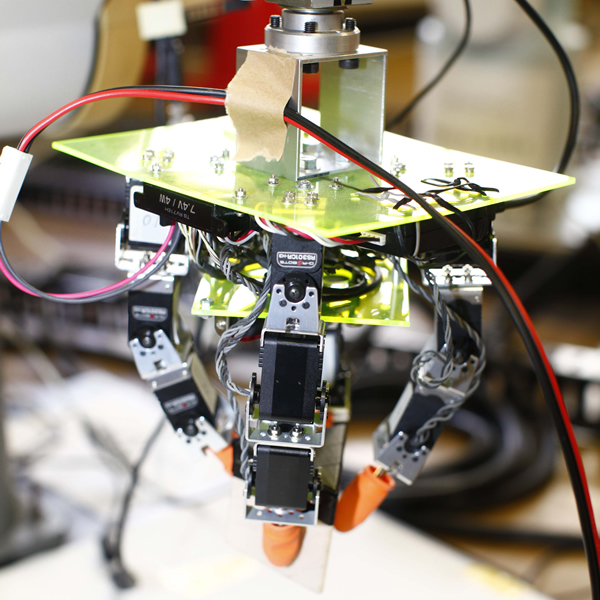
Intelligent Mechanical Engineering Course
Overview:
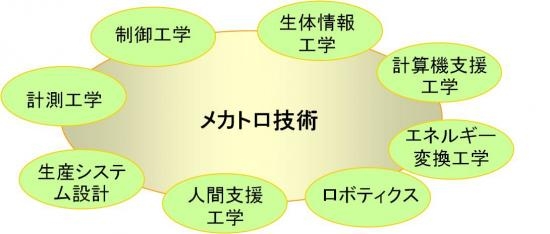
With the advancement of industrial activities, the importance of mechatronics and system integration (SI) technologies--built upon mechanical engineering and integrated with information science and electrical/electronic engineering--is continuing to grow.
The Intelligent Mechanical Systems Course covers a wide range of fields, including robotics, control systems engineering, energy engineering, human assistive engineering, virtual reality, and space propulsion engineering. Closely connected with cutting-edge technologies such as AI, IoT, and collaborative robotics, the course promotes the creation and application of new academic knowledge in intelligent mechanical systems. Its goal is to cultivate engineers and researchers who can contribute actively to both industry and advanced research.
Students systematically study these academic fields and develop practical problem-solving skills by engaging in the development of advanced technologies such as intelligent robots and energy-efficient systems.
Educational Features:
The Intelligent Mechanical Systems Course provides education in mechatronics and system integration (SI) technologies by combining mechanical engineering with information science and electrical/electronic engineering, thereby fostering practical skills applicable to a wide variety of fields.
Through the four-year curriculum, students systematically study mechanics, control engineering, robotics, data science (including AI programming), measurement engineering, electrical and electronic engineering, energy engineering, space propulsion engineering, and human assistive engineering.
As the culmination of their studies, students join research laboratories where they engage in cutting-edge research in diverse areas such as intelligent robots, autonomous mobility systems, next-generation actuators, smart manufacturing systems, assistive technologies, space propulsion technologies, and energy systems.
Specific research topics include:
- Robot control (structural analysis, object grasping, motion control)
- Autonomous mobile robots (3D SLAM, wheeled/legged locomotion systems)
- Teleoperation systems
- Drone applications
- Camera image analysis (deep learning and image processing)
- Virtual reality
- Haptic devices
- Next-generation actuators (polymer-based actuators and two-degree-of-freedom motors)
- Smart manufacturing systems utilizing IoT technologies
- Welfare and assistive robots (myoelectric prosthetic hands and brain-machine interfaces)
- Space propulsion technologies
- Hydrogen energy utilization technologies
Through an education that emphasizes a balance between hardware and software, the course nurtures the creativity and practical engineering skills required of engineers and researchers involved in next-generation intelligent mechanical systems.







GIFU UNIVERSITY FACULTY OF ENGINEERING and GRADUATE SCHOOL OF ENGINEERING
1-1 Yanagido, Gifu City 501-1193, JAPAN Phone; +81-(0)58-230-1111